

Confidence mindfulness is not about pretending doubt is gone. It is a practical way to notice self-critical chatter, steady your body, and take the next useful action while doubt is still present.
Key takeaways
1. Catch: Notice one sign of self-doubt, such as tight shoulders, a racing story, or the urge to avoid.
2. Anchor: Feel both feet on the floor. Let the jaw soften. Breathe low and slow without forcing a special rhythm.
3. Label: Say silently, “I am having the thought that I will mess this up,” or “This is anxiety in my chest.”
That distinction matters under pressure. In a meeting, presentation, difficult conversation, or training session, confidence often drops before your actual skill changes. Your attention narrows, your body feels louder, and the inner critic starts presenting guesses as facts.
This guide gives you immediately usable practices: a 60-second reset, a 5-minute guided script, a simple 14-day experiment, and a tracking structure that separates real progress from mood noise.
Where confidence mindfulness fits in performance and health
Mindfulness is present-moment, non-judgmental awareness. Meditation is one method for training that skill. The point is not to empty your mind. The point is to notice what is happening without automatically obeying every thought, sensation, or fear prediction.
Confidence can be influenced by the state of your nervous system. Poor sleep, heavy stress load, under-recovery, and training fatigue may make ordinary challenges feel larger. If you train hard, the same restlessness you call “low confidence” might sometimes be a recovery signal, similar to the patterns described in watch for signs you need a deload week.
Metabolic context can matter too, but it should be interpreted cautiously. Too much caffeine, long gaps between meals, dehydration, or blood sugar swings can feel like anxiety, shakiness, or brain fog. If you are exploring nutrition patterns, broad education such as lowering blood sugar with cinnamon can be useful context, but confidence work still comes down to attention, behavior, and recovery.
For a broader view of attention, self-talk, and emotional regulation, the Mindset & Mental Health overview is the natural hub. Confidence mindfulness sits inside that larger skill set: it helps you respond more flexibly when your.
Quick answer
Mindfulness can support confidence by changing how you relate to self-doubt, not by forcing positive thoughts. A simple approach is: notice the inner critic, label it, return attention to the breath or body, then take one small values-based action. Confidence follows evidence, and evidence comes from repeated approach behavior.
The 60-second Confidence Reset
- Catch: Notice one sign of self-doubt, such as tight shoulders, a racing story, or the urge to avoid.
- Anchor: Feel both feet on the floor. Let the jaw soften. Breathe low and slow without forcing a special rhythm.
- Label: Say silently, “I am having the thought that I will mess this up,” or “This is anxiety in my chest.”
- Move: Choose the smallest useful action: ask the first question, open the document, start the warm-up, or make eye contact.
As a practical starting point, experiment with 5 minutes of confidence mindfulness on several days per week plus the 60-second reset before stressful moments. These are practical defaults, not medical rules or guaranteed timelines.
If you want to make the reset easier to repeat, use Coach check-ins in the huuman app to log your confidence reset before stressful moments and compare what happened against what.
Define the target before you train it
Confidence is your context-specific belief that you can handle a task or situation. You might feel confident lifting, uncertain presenting, and calm in one-on-one conversations.
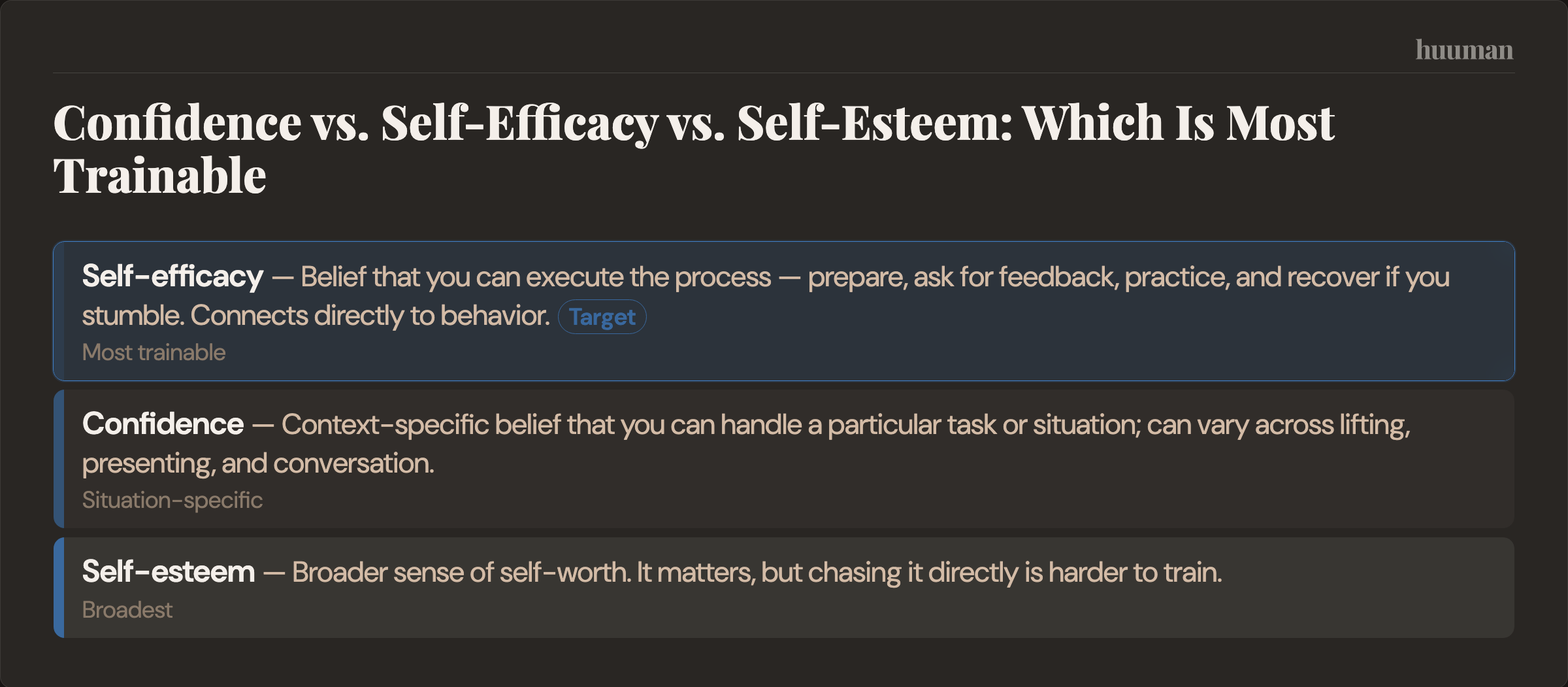
Self-efficacy is your belief that you can execute the process. It sounds like, “I can prepare, ask for feedback, practice the opening, and recover if I stumble.” This is often the most trainable lever because it connects directly to behavior.
Self-esteem is your broader sense of self-worth. It matters, but chasing self-esteem boosts can become fragile because it depends on feeling good about yourself. Self-compassion is often a better lever: it lets you act with steadiness even when you feel imperfect, exposed, or behind.
This is why advice to simply believe in yourself can feel incomplete unless it is tied to repeatable actions. Confidence mindfulness works best when it turns “I hope I feel confident” into “I can notice doubt, regulate enough, and take the next rep.”
Why mindfulness can change confidence
The inner critic is not always wrong, but it is rarely balanced under pressure. It tends to over-weight danger, under-weight your preparation, and turn sensations into identity statements. “My heart is racing” becomes “I am not ready.” “I made one mistake” becomes “I am bad at this.”
Mindfulness creates space between the event and the reaction. That space is cognitive defusion: seeing a thought as a thought rather than as an instruction. The line “I am having the thought that I will fail” is not magic. It works because it changes your relationship to the thought. You can carry doubt without making it the decision-maker.
The body matters because confidence is partly interpreted through sensation. Jitters may mean threat, excitement, caffeine, poor sleep, or normal performance arousal. A somatic anchor such as feet, jaw, shoulders, or breath gives attention somewhere stable to return to. You relax what you can, breathe lower and slower, and stop treating every spike of arousal as proof that something.
This same principle applies to fitness. A runner may feel underconfident because a hard session felt flat after poor sleep. A lifter may mistake normal pre-set arousal for being unprepared. If motivation is the challenge, how to stay motivated to work out and motivation for runners add useful behavior-focused context.
The C.A.L.M. loop: a simple diagram you can remember
Use this as a practical sequence, not a personality test or a promise of instant calm.

- C: Catch. Notice the first signal: rumination, avoidance, jaw tension, shallow breathing, checking behavior, or rehearsing failure.
- A: Anchor. Pick one contact point: feet on the ground, hands on thighs, breath moving low in the ribs, or shoulders dropping slightly.
- L: Label. Name the experience: “worry thought,” “tight chest,” “urge to disappear,” or “I am having the thought that I am not enough.”
- M: Move. Take one values-based action that would still matter if confidence stayed imperfect.
The final step is what separates mindfulness from avoidance disguised as self-care. If you only calm down but never approach the situation, you may reinforce the sense that escape created safety. If you calm enough to take a small rep, you give yourself new evidence, which fits how inhibitory learning supports extinction.
Evidence and limits
No external studies were provided for this article, so it would be inappropriate to claim specific effect sizes, brain changes, cortisol reductions, or exact timelines. The practical case for confidence mindfulness is strongest when viewed as a combination of attentional training, self-compassion, reduced rumination, and approach behavior.
Where the rationale is relatively strong: many mindfulness-based approaches emphasize noticing thoughts and sensations without automatic reaction, and self-compassion practices are commonly used to reduce harsh self-judgment. These mechanisms fit the confidence problem because self-doubt often becomes disabling when it narrows behavior.
Where the limits are important: mindfulness does not replace skill acquisition. If you are unprepared for a presentation, mindfulness may help you notice panic, but practice, feedback, and clearer structure still matter. If social confidence is low because you avoid every interaction, quiet meditation alone may not build enough real-world evidence.
Some people may feel more anxious when they first turn toward the body or breath. If that happens, you might consider eyes-open practice, grounding through the feet, shorter sessions, or practicing with a qualified professional. Mindfulness should not be forced through overwhelming distress.
Practical strategies to discuss or experiment with
A 5-minute guided “quiet confidence” practice
Read this slowly or record it in your own voice.
Sit, stand, or lie down in a position that feels stable. Let your eyes close or rest on one point. Notice the contact between your body and the surface beneath you.
Bring attention to your feet, hands, or breath. You do not need to breathe perfectly. Just notice one inhale and one exhale.
Now invite the situation where you want more confidence. Not the whole story, just the next real moment: walking into the room, starting the conversation, beginning the set, or opening the call.
Notice what appears. A thought, a feeling, a sensation, an image. Label it gently: “planning,” “worry,” “tightness,” “self-criticism,” or “I am having the thought that I cannot handle this.”
Place one hand on the chest or keep both feet grounded. Say silently: “This is hard. Many people feel this under pressure. I can take one useful step.”
Ask: what is the smallest action that would express courage, honesty, preparation, or consistency? Choose one rep. End by feeling the body breathe once more, then open your eyes and do the next action when appropriate.
A 2-minute before-the-event protocol
Before a meeting, presentation, tough conversation, or training session, use a short pre-mortem. Define the smallest acceptable outcome. For example: “If I explain the main point clearly and ask one useful question, this counts as a rep.” This prevents perfectionism from moving the goalposts mid-event.
Then set an implementation intention: “If I lose my train of thought, I will pause, breathe once, and return to my next sentence.” If you are training, it might be: “If the warm-up feels heavy, I will slow down and focus on clean reps rather than judging the whole session.”
Mindful exposure reps
Earned confidence grows through approach behavior. Build a small ladder with one easy, one medium, and one hard rep. For a meeting, easy might be asking one clarifying question. Medium might be presenting a short update. Hard might be leading the discussion.
Pair each rep with the C.A.L.M. sequence. Catch the cue, anchor the body, label the story, move toward the smallest useful action. This keeps the practice from becoming abstract.
Self-compassion for the inner critic
Self-compassion is not denial and it is not letting yourself off the hook. It is a steadier way to stay engaged. The micro-script is simple: “This is hard. I am not the only person who feels this. I can take one step that matters.”
If your inner critic uses ambition as a weapon, revisit the difference between standards and self-attack. Strong goals can coexist with psychological flexibility, as explored in ambition and goal-setting.
Minimal, standard, and advanced weekly plans
- Minimal: Use the 60-second reset once daily, do the 5-minute practice on three days, and complete one values-based confidence rep during the week.
- Standard: Practice for 5 to 10 minutes on most days, use the reset before pressure moments, and complete two or three small approach reps.
- Advanced: Practice for 10 to 20 minutes on most days, build a structured rep ladder, and review patterns weekly. Back off if practice increases dread, avoidance, sleep disruption, or rumination.
Timing is flexible. If mornings help consistency, use them. If evenings help reflection, that can work too. For more context, see the best time of day to meditate and alpha brain wave meditation.
A 14-day confidence mindfulness experiment
Use one practice and one micro-action. Do not redesign your personality in two weeks. The goal is to collect evidence about what helps you act with more steadiness.

- Day 1: Choose one context, such as meetings, social conversations, or training sessions.
- Day 2: Write your common inner critic line and one defused version: “I am having the thought that...”
- Day 3: Practice the 5-minute script once.
- Day 4: Use the 60-second reset before one small task.
- Day 5: Complete one easy approach rep.
- Day 6: Track sleep quality and stress load as context, not as excuses.
- Day 7: Review one prediction your inner critic made and what actually happened.
- Day 8: Repeat the 5-minute practice and choose a medium rep.
- Day 9: Use the self-compassion script after a mistake.
- Day 10: Practice one short moment without guided audio.
- Day 11: Use a pre-mortem before a pressure event.
- Day 12: Complete another approach rep and keep the goal small.
- Day 13: Notice whether confidence rises after action rather than before it.
- Day 14: Decide what to keep, reduce, or stop based on behavior, not just mood.
How to track and interpret changes
Track situations, not your entire emotional life. Confidence is context-specific, so a useful log captures where self-doubt appears, what story it tells, what the body does, which skill you used, and what the next rep should be.
- Example entry: Monday team meeting. Story: “Everyone will notice I am unsure.” Sensation: tight jaw and fast breathing. Skill used: feet anchor plus “I am having the thought that...” Next rep: ask one question earlier in the meeting.
- Before and after rating: Use a simple “I can handle this” score from 0 to 10 before and after the reset. Treat it as a rough signal, not a diagnosis.
- Approach behavior: Count situations approached versus avoided. This is often more useful than asking whether you felt confident all day.
- Recovery context: Note sleep quality, stress load, hard training, and body image triggers. Recovery tools such as sleep music or hot tub muscle recovery may support the broader environment, but they do not replace approach reps.
- Learning context: If you are interested in brain health and adaptation more broadly, how to increase bdnf offers related background, but avoid turning confidence into a biomarker chase.
Do not overinterpret minute-by-minute mood. A useful week can include anxiety, awkwardness, and imperfect practice if you approached what matters with slightly more flexibility.
For a clearer pattern over time, your huuman Coach can interpret weekly confidence trends alongside sleep, recovery, training load, and goals so the next plan reflects your actual constraints rather than a rigid mindfulness streak.
Signal vs noise
- Mindfulness is not a confidence hack. If you are using it to avoid action, choose one small approach rep before adding more meditation.
- Anxiety does not prove you are unprepared. Reappraising stress as functional can reduce threat appraisals, so compare the sensation with your preparation and consider writing one concrete next step.
- Guided audio is useful, but dependence can limit transfer. Audio-guided meditation can match in-person guidance for emotion regulation, so you may benefit from practicing one short reset without audio in the place you need confidence.
- High arousal is not always bad. If the energy is usable, channel it into the first action instead of trying to erase it.
- Confidence is situation-specific. Track the meeting, lift, conversation, or presentation rather than making a global judgment about yourself.
- Self-compassion is not softness. Use it to stay engaged after a mistake, then identify the next rep.
- Comparing your inside to someone else’s outside distorts reality. Curated, idealized self-presentations invite comparison with seemingly superior others, so judge progress against your previous avoidance pattern.
- When distress is intense, mindfulness alone may not be enough. Consider support from a qualified clinician or mental health professional.
When to consult a professional
Get professional support promptly if low confidence is tied to suicidal thoughts, self-harm urges, feeling unsafe, panic attacks with chest pain or fainting, severe shortness of breath, trauma flashbacks, dissociation, persistent low mood or loss of function for weeks, or substance use to cope with anxiety or confidence issues. If you have thoughts of ending your life, help and support is available right now.
If meditation makes you feel more panicky, unreal, flooded, or trapped in traumatic material, stop forcing the practice. Increased body awareness during meditation can be linked to anxiety, panic, and dissociation for some people, so grounding and clinician-guided support, alongside options like gentle movement or eyes-open attention, may feel safer than sitting silently with internal sensations.
Common questions
How does mindfulness build confidence without positive thinking?
It helps you notice self-doubt without automatically obeying it. Instead of replacing “I will fail” with “I will be amazing,” you label the thought, steady the body, and take one useful action. That action creates evidence.
Is confidence the same as self-esteem?
No. Confidence is task-specific, self-efficacy is process-specific, and self-esteem is global self-worth. If you want the most practical lever, train self-efficacy: the belief that you can execute the next steps even when feelings fluctuate.
How long does it take for mindfulness to affect confidence?
There is no reliable universal timeline. Some people notice an immediate shift in how they relate to thoughts, while deeper confidence usually depends on repeated real-world reps. Judge progress by approach behavior, not only by how calm you feel.
What is the best quick exercise before a presentation or meeting?
Use the 60-second reset: catch the cue, anchor your body, label the thought, and move into the smallest useful action. Pair it with a pre-mortem: define the smallest acceptable outcome before you start.
Can mindfulness help social confidence and overthinking?
It can help you recognize rumination as mental activity rather than truth, an ability often called decentering from thoughts and feelings. For social confidence, the practice tends to work best when paired with small approach reps such as asking one question, sending one message, or staying present for one extra minute.
Should I use guided meditations or practice in silence?
Guided practice is a good starting point because it lowers friction. Silent or lightly guided practice helps transfer the skill into real situations. Many people benefit from using both.
What if meditation makes me more anxious?
Shorten the practice, keep your eyes open, use external anchors, or pause meditation and try grounding through movement. If anxiety is intense, trauma-linked, or functionally impairing, work with a qualified professional.
Confidence mindfulness works best when it stays honest: notice what is happening, soften the fight with yourself, and take one action that proves you can participate before you feel perfectly ready.
More health topics to explore
- Mindset, Stress & Mental Health – Overview
- How to Increase BDNF: The Training, Sleep, Stress, and Nutrition Levers That Matter
- Electrodermal Activity (EDA) Score: Meaning, “Good” Ranges, and How to Interpret Your Trend
- How to Focus on Yourself: Without Feeling Selfish
References
- Breines JG & Chen S — Self-compassion increases self-improvement motivation (2012)
- Hede AJ — Using mindfulness to reduce the health effects of community reaction to... (2017)
- Seth AK — Interoceptive inference, emotion, and the embodied self (2013)
- Craske MG et al. — Optimizing inhibitory learning during exposure therapy (2008)
- Jamieson JP et al. — Reappraising stress arousal improves affective, neuroendocrine, and academic... (2022)
- Buric I et al. — Teacher-Guided vs. Self-Guided Mindfulness in Higher Education: Comparable... (2026)
- Social comparison and idealized self-presentation on social media (2023)
- NHS — Help for suicidal thoughts
- Britton WB et al. — Defining and measuring meditation-related adverse effects in... (2021)
- Decentering in mindfulness-based treatments (2021)
About this article · Written by the huuman Team. Our content is based on peer-reviewed research and clinical guidelines. We follow editorial standards grounded in scientific evidence.
This article is for educational purposes only and does not constitute medical advice. Health and training decisions should be discussed with qualified professionals.

