

If your sleep tracker suddenly shows too little REM sleep, the first question is not, “How do I increase REM tonight?” It is: is the device really detecting less REM, or is your sleep too short, too fragmented, or being misclassified?
Key takeaways
1. Check the measurement first: a new tracker, firmware update, very short nights, lots of movement, or a loose fit can distort sleep-stage estimates.
2. Check sleep amount and timing: if you are not spending enough time in bed or your wake-up time varies a lot, low REM is plausible.
3. Check fragmentation: frequent awakenings, bathroom trips, noise, light, children, a partner, or breathing problems can break up sleep cycles.
REM sleep matters for emotional processing, learning, memory, and vivid dreaming. But it is not an isolated performance switch. If you focus only on the REM number, you may miss the bigger levers: more uninterrupted sleep time, a steadier sleep schedule, and fewer nighttime disruptions.
This guide will help you interpret low REM readings in a practical way: tracker error, sleep architecture, alcohol, stress, training, medications, and warning signs that deserve medical attention. The goal is not perfect sleep optimization. It is better decision-making.
Why REM Sleep Matters for Recovery
Sleep is not one uniform state. Your brain cycles between NREM sleep and REM sleep. NREM includes lighter stages and deep sleep, while REM is characterized by rapid eye movements, high brain activity, and reduced muscle tone. In sleep medicine, REM is often described as making up roughly one fifth to one quarter of adult sleep, although individual nights can vary a lot.

A sleep cycle lasts about 90 to 120 minutes. Earlier cycles usually contain more deep sleep, while later cycles contain more REM. That is why a shortened night can affect REM especially strongly: if you regularly cut off the last part of your sleep, you often lose the phase where REM tends to be more prominent.
For broader context on recovery, sleep pressure, and restoration, see our overview of sleep and recovery. If you want to understand whether your total sleep duration is within a typical range, the benchmark on average sleep duration in Germany adds useful comparison.
Quick Answer
Too little REM sleep usually means one of three things: your tracker is estimating low REM, your total sleep time is too short, or your sleep is interrupted often enough that REM phases are shortened. The safest first lever is not a supplement or a biohack. It is more uninterrupted total sleep.
- Check the measurement first: a new tracker, firmware update, very short nights, lots of movement, or a loose fit can distort sleep-stage estimates.
- Check sleep amount and timing: if you are not spending enough time in bed or your wake-up time varies a lot, low REM is plausible.
- Check fragmentation: frequent awakenings, bathroom trips, noise, light, children, a partner, or breathing problems can break up sleep cycles.
- Check substances: evening alcohol, late caffeine, nicotine, and cannabis can affect sleep architecture and continuity.
- Check red flags: loud snoring, breathing pauses, strong daytime sleepiness, morning headaches, or new medications should be discussed with a clinician.
If you want to look at trends rather than single-night values, you can track your sleep duration and sleep stages over time in the huuman app and see whether low REM lines up with real-world signs in daily.
What “Too Little REM” Can Mean in Practice
A low REM value only becomes meaningful when you separate three scenarios. First: you are not sleeping much overall. In that case, your absolute REM time may be low even if the percentage is normal. Second: your sleep duration is adequate, but the tracker estimates a low REM share. Third: your night is fragmented, so cycles are repeatedly interrupted.

This distinction leads to better decisions. If you sleep six short, restless hours, you probably do not need a REM strategy as much as you need better sleep continuity. If you sleep eight hours, feel recovered, and only one device reports low REM, the tracker value deserves less weight.
Dream recall is not a reliable REM marker either. You can have plenty of REM and remember no dreams. You can remember a dream because you woke directly out of REM. That says little about the total amount.
Mini Decision Tree: Tracker Issue or Real Signal?
- Did only the number change? If daytime energy, mood, focus, and training performance are stable, watch the trend for 7 to 14 days before judging a single night.
- Were there technical changes? A new tracker, a different wrist, a software update, or a poor fit points more toward measurement noise.
- Was the night short? Too little time in bed, falling asleep late, or waking early often explains a low REM estimate better than a specific REM problem.
- Was the night interrupted? More wake time after sleep onset, also called WASO, is a strong sign of fragmented sleep.
- Are there physical warning signs? Snoring with breathing pauses, severe daytime sleepiness, or falling asleep while driving is not a biohacking issue. It is a reason to seek medical assessment.
Common Reasons for Low REM Sleep
- A short night: Because REM becomes more common toward morning, waking early can cut off later REM phases. The first safe lever is more consistent time in bed.
- An irregular rhythm: Highly variable wake-up times shift circadian signals. A consistent wake time and morning light can help stabilize your rhythm.
- Sleep fragmentation: Noise, light, bathroom trips, pain, or breathing disturbances increase wake periods. The first lever is fewer interruptions, not more stage optimization.
- Alcohol: Alcohol can feel sedating at first, but it is associated with altered sleep structure and more restlessness in the second half of the night. A two-week alcohol-free experiment is often more informative than day-to-day comparisons.
- Caffeine, nicotine, and THC: Effects vary by person. Late caffeine can interfere with falling asleep and staying asleep, nicotine is stimulating, and cannabis can alter REM and may be linked with REM rebound when reduced or stopped.
- Stress and hyperarousal: Rumination, anxiety, work pressure, and evening stimulation keep the nervous system activated. This often fits with early waking, as explained in our guide to the “wolf hour” and sleep.
- Late, hard training sessions: Regular training is generally sleep-supportive, but late high-intensity workouts can raise temperature, heart rate, and mental activation in some people.
- Medications: Antidepressants such as SSRIs, SNRIs, and tricyclics, stimulants, benzodiazepines, Z-drugs, and beta blockers can affect sleep architecture. Any changes should always be discussed with a clinician.
- Sleep disorders and health conditions: Obstructive sleep apnea, restless legs syndrome, periodic limb movements, chronic pain, depression, anxiety, and neurological conditions can alter sleep architecture and continuity.
Fragmentation Matters More Than Sleep Stages
The most common thinking error is: “My REM is low, so I need to increase REM.” A more useful question is: “What is interrupting my sleep cycles?” REM does not occur in isolation from the rest of sleep. If you wake up repeatedly, cycles are cut short, restarted, or misclassified by the tracker.
Sleep continuity includes sleep onset latency, wake time after sleep onset, and the number of interruptions. A night with slightly less REM but long uninterrupted blocks may feel more restorative than a supposedly “optimized” night with many wake periods.
Typical signs of fragmentation include dry mouth in the morning, headaches, frequent urination, restless sleep, a bed partner reporting snoring or breathing pauses, and daytime sleepiness despite enough time in bed. If these signs appear, the next step is not trying to increase REM sleep with tricks. It is identifying possible causes properly.
Substances, Light, and Evening Habits
Alcohol is the classic example: it can make you feel sleepy faster, but that is not the same as better sleep quality. Many people see more wake periods, a higher nighttime heart rate, or a more restless second half of the night after drinking. If you want to know whether alcohol is your driver, do not compare Friday with Tuesday. Compare several similar nights with and without alcohol.
Caffeine does not need a rigid rule so much as a personal cutoff window. Some people tolerate coffee in the afternoon; others see worse sleep onset or more wake time even with earlier intake. Nicotine is stimulating and can disrupt sleep continuity. THC and cannabis are more complex: some people feel they fall asleep more easily, while evidence on cannabis and REM suppression is mixed, though REM rebound when use is reduced or stopped is a more.
REM pressure and REM rebound mean that after REM suppression, sleep loss, or substance changes, the body may temporarily make up more REM. This is not proof that “damage” occurred before, and it is not a target you need to chase. It is more a sign that sleep is dynamically regulated.
Light also matters. Morning light stabilizes the circadian rhythm, while bright light and screen-related stimulation in the evening can make it harder to fall asleep. If you are working on environmental factors, darkness, quiet, and a comfortable room climate matter more than accessories. Sleep aids such as deep sleep pillow spray or an anti-aging pillow can support a ritual, but they do not replace a stable sleep.
Stress, Rumination, and the Brain at Night
Hyperarousal describes a state in which your body is tired but your system remains internally activated. It can come from work stress, conflict, anxiety, news, late emails, or constant problem-solving. When that happens, falling asleep becomes harder, and waking up during the night becomes more likely.
One useful approach is a short cognitive “offload” in the evening: write down open tasks, identify the next first step, and make a deliberate decision not to keep planning in bed. Breathing routines can also help mark the transition. If you want a specific technique, the guide to the 4-7-8 breathing technique explains a simple structure.
When mental load is high, it is worth looking at the broader pattern too. Our guide to mental overload can help distinguish ongoing strain from normal pressure. Acute nervousness, such as before presentations or competitions, follows similar activation pathways, which is why ways to overcome stage fright also include strategies that can support evening calm.
Training and Recovery: When Exercise Helps and When It Interferes
Regular movement is associated with better sleep, but timing and total load matter. Late intense sessions can keep heart rate, body temperature, and mental activation elevated long enough to make it harder for some people to fall asleep or stay asleep. This does not apply to everyone or to every workout.
Training literature often describes moderate sessions, easy endurance work, or evening mobility as better tolerated by many people than hard intervals late in the day. If you can only train in the evening, the better test is not “exercise or no exercise,” but adjusting intensity, duration, and how you wind down afterward.
If low measured REM coincides with lower motivation to train, heavy soreness, or tired legs, total load may be part of the picture. The articles recognizing when you need a deload week and whether to keep training with muscle soreness can help you interpret sleep data alongside recovery and training.
Medical Causes and Warning Signs
Obstructive sleep apnea is one of the most important causes not to miss. It is associated with repeated airflow restrictions, oxygen drops, and arousals. This can fragment sleep and change sleep stages. Signs include loud snoring, observed breathing pauses, morning headaches, dry mouth, high blood pressure, and strong daytime.
Restless legs, periodic limb movements, chronic pain, depression, anxiety disorders, and neurological conditions can also be relevant. Acting out dreams at night is especially important to notice, including hitting, kicking, or risk of injury. This can point to REM sleep behavior disorder and should be medically evaluated.
Medications are their own decision area. Antidepressants such as SSRIs, SNRIs, and tricyclic antidepressants can suppress REM or change REM latency. Stimulants can affect sleep timing and continuity. Benzodiazepines, Z-drugs, and beta blockers can also change sleep patterns. Do not stop anything on your own. Bring your sleep data, symptoms, and the timing of changes into a medical conversation.
Evidence and Limits
The biggest practical limitation is wearables. Watches and rings can often show useful trends in sleep duration, timing, resting heart rate, and movement patterns. Sleep stages are harder: devices estimate REM indirectly from movement, heart rate, heart rate variability, and algorithms. That is not the same as polysomnography in a.
That is why a single value such as “0 minutes of REM” is usually not a reliable finding. A consistently low trend over several weeks is more meaningful, especially if it lines up with fatigue, trouble concentrating, lower mood, or reduced performance. Subjective markers are not perfect either, but they add context.
Observational studies suggest that a lower share of REM may be associated with unfavorable health outcomes. That does not prove causality for an individual person. Low REM may be a cause, a consequence, or a marker of other factors, such as age, illness, medications, stress.
Conservative Strategies to Discuss With Professionals
A sensible order starts with the big levers. First: stabilize sleep time and rhythm. A consistent wake time, morning light, and enough time in bed are usually more robust than fine-tuning individual stages. Second: reduce disruptors, especially alcohol, late caffeine, light, noise, and notifications.
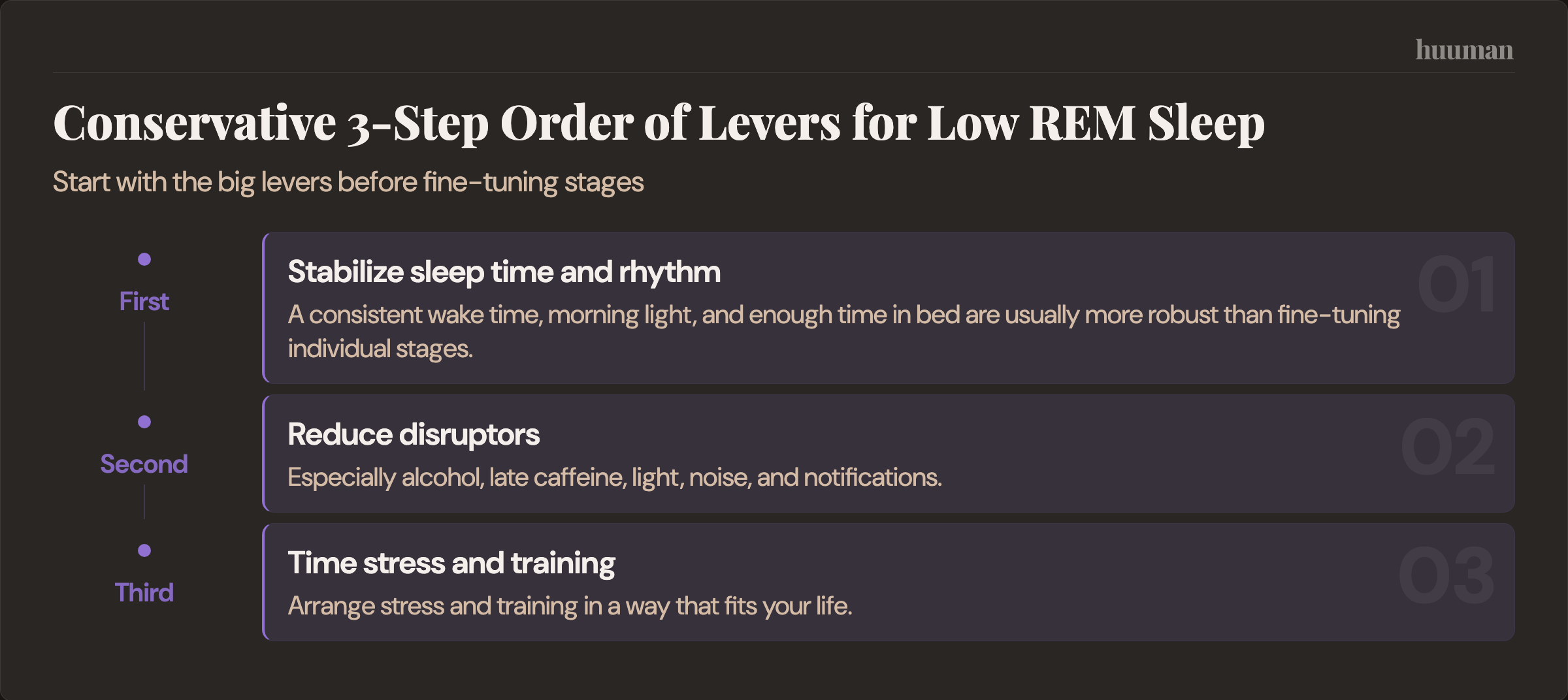
Third: time stress and training in a way that fits your life. A common 7-day test includes a consistent wake time, alcohol-free evenings, and a short 30- to 60-minute wind-down. A 14-day test adds light management, a caffeine cutoff window, and a simple evening routine. A 4-week approach can include training load, deload planning, and structured stress interventions.
If you only change two things, choose a consistent wake time and less alcohol in the evening. This combination improves decision quality quickly because it removes two common disruptors without pushing you into risky self-treatment or supplement dosing.
Late heavy meals can affect sleep comfort, reflux, or nighttime waking in some people. If food, alcohol, weight, and metabolism are all part of the picture, the article on whether high triglycerides can lead to weight gain can help you avoid blaming sleep alone for metabolic signals.
A 7-Day Experiment and 14-Day Tracking Plan
For seven days, a compact experiment is enough. Keep your wake time as consistent as possible, plan a calm final hour, reduce evening alcohol, watch late caffeine, and note interruptions. The goal is not to force more REM sleep. It is to make the most likely disruptors visible.
- Days 1 to 2: Capture a baseline: time in bed, sleep duration, awakenings, daytime energy, alcohol, caffeine, and training.
- Days 3 to 5: Keep your wake time stable, skip alcohol or stop drinking much earlier, and reduce evening notifications.
- Days 6 to 7: Check whether wake periods, energy, mood, or resting heart rate respond more clearly than the REM value itself.
For 14 days, a score sheet is more useful than a simple REM list. A realistic example entry: Monday, wake time 6:45 a.m., time in bed 7:50 hours, two brief wake periods, energy 7 out of 10, no alcohol, caffeine until early afternoon, easy training, REM below personal average according to tracker. That line tells you more than the REM value alone.
When reviewing the data, prioritize wake-time consistency, time in bed, wake time after sleep onset, daytime energy, concentration, and mood. Secondarily, you can look at REM trends over 7 to 14 days, plus resting heart rate and HRV over several days. HRV is a decision-support tool, not an oracle.
If you want to turn the data into practical next steps, your huuman Coach can adapt weekly plans to your sleep, recovery, training, and available time, instead of forcing rigid routines into your real.
Signal and Noise When REM Looks Low
- Signal: A low REM trend for more than two weeks, combined with fatigue or concentration problems. Check sleep amount, fragmentation, and medications systematically.
- Signal: More uninterrupted sleep time alongside better daytime energy. Keep the routine, even if REM does not rise every night.
- Signal: Less WASO and fewer nighttime awakenings. Keep looking for disruptors such as noise, light, alcohol, or breathing issues.
- Signal: Better mood and steadier focus. Weigh that more heavily than a perfect sleep-stage chart.
- Signal: A lower resting heart rate trend with a better sense of recovery. Compare several nights rather than single spikes.
- Noise: One night with 0 to 5 minutes of REM according to a tracker. Repeat the measurement and check fit, battery, updates, and sleep duration.
- Noise: Dream recall as a quality metric. Use it as a note, not as a REM diagnosis.
- Noise: Stage optimization without enough sleep time. Improve continuity and rhythm first, then interpret individual stages.
- Noise: Biohacks that mask alcohol, stress, sleep apnea, or nights that are simply too short. Remove the big disruptors first.
Common questions
What should I do if I am getting too little REM sleep?
Start with a 7- to 14-day trend. First check sleep duration, a consistent wake time, wake periods, alcohol, late caffeine, stress, training timing, and new medications. If warning signs such as loud snoring, breathing pauses, or strong daytime sleepiness are present, medical evaluation matters more than self-optimization.
How much REM sleep do you need per night?
There is no perfect REM-minute target for everyone. In adults, REM is often described as roughly 20 to 25 percent of sleep, but age, sleep duration, stress, medications, and measurement method all affect the number. A stable routine with good daytime function matters more than an isolated percentage.
What most often suppresses REM sleep?
Common drivers include short nights, an irregular rhythm, alcohol, late caffeine, nicotine, cannabis or THC, stress, fragmented sleep, sleep apnea, and certain medications. In practice, alcohol, sleep loss, and interruptions are often the first things you can test cleanly.
What is more important: REM sleep or deep sleep?
Both serve different functions. Deep sleep is more closely linked with physical recovery and sleep pressure, while REM is more closely linked with emotional processing, learning, and dreaming. The better question is: are you getting enough continuous sleep cycles? Pitting individual stages against each other rarely leads to better decisions.
Why does my Fitbit, Garmin, or Oura show so little REM?
Wearables estimate sleep stages indirectly and can confuse REM with light sleep or wake periods. Very short nights, movement, poor fit, alcohol intake, restless sleep, or algorithm changes can alter the estimate. Use the REM value as a trend, not a diagnosis.
Can alcohol reduce REM sleep?
Alcohol can affect sleep architecture and continuity. Many people fall asleep more easily at first but experience a more restless second half of the night. To test the effect, compare several similar evenings with and without alcohol and assess wake periods, resting heart rate, energy.
Which medications affect REM sleep?
SSRIs, SNRIs, tricyclic antidepressants, stimulants, benzodiazepines, Z-drugs, and beta blockers can all alter sleep stages, among others. That does not mean a medication is wrong. It means sleep changes should be discussed with a doctor, especially after starting a new medication or changing the dose.
When to Seek Medical Assessment
Loud regular snoring with observed breathing pauses, severe daytime sleepiness, microsleeps, falling asleep while driving, morning headaches, dry mouth, newly high blood pressure, or acting out dreams at night are clear reasons to involve a professional.
Ongoing sleep deterioration after new medications, strong anxiety or depressive symptoms, chronic pain, tingling or an urge to move the legs, and any risk of injury during sleep also do not belong in tracker optimization alone. If children or family members are affected by sleep and concentration issues, the article on concentration in children can help you consider daytime function more broadly.
If you do not want to interpret your patterns alone, the huuman Coach can help put your sleep trends into context and prioritize next steps, without making individual REM nights more important than the bigger picture.
More health topics to explore
- Sleep & Recovery – Overview
- Anti-Age Pillow: Do “Anti-Wrinkle” Pillows Work, and Which Type Fits You?
- Signs You Need a Deload Week
- Best Recovery Slides (2026): A Stability-First Buying Guide
References
- Lee T et al. — Accuracy of 11 Wearable, Nearable, and Airable Consumer Sleep Trackers: Prosp... (2023)
- Korkalainen H et al. — Detailed Assessment of Sleep Architecture With Deep Learning and Shorter... (2021)
- Deutsches Ärzteblatt — Schlafqualität: Geringere Anteile von REM-Schlaf sind mit höherer Mortalität assoziiert
- Gervasoni et al. — Effect of chronic treatment with milnacipran on sleep architecture in rats compared with paroxetine and imipramine. (2002)
- Cappuccio et al. — Sleep duration and all-cause mortality: a systematic review and meta-analysis of prospective studies. (2010)
- Baglioni et al. — Sleep and mental disorders: A meta-analysis of polysomnographic research. (2016)
- Feriante et al. — REM Rebound Effect (2026)
- Parrino et al. — The 70 years since the discovery of rapid eye movement sleep: history, electroencephalographic features and unsolved issues. (2025)
- Luna-Rangel FA et al. — Efficacy of blue-light blocking glasses on actigraphic sleep outcomes: a... (2025)
- Velzeboer R et al. — Cannabis and sleep architecture: A systematic review and meta-analysis (2025)
- Dauvilliers Y et al. — REM sleep behaviour disorder (2018)
- Szynkarek A et al. — Restorative or Disruptive? Effects of Antidepressants on Sleep Architecture... (2026)
- Chaput JP — Alcohol, Wine, and Sleep in Adults: Insights from a Narrative Review (2026)
About this article · Written by the huuman Team. Our content is based on peer-reviewed research and clinical guidelines. We follow editorial standards grounded in scientific evidence.
This article is for educational purposes only and does not constitute medical advice. Health and training decisions should be discussed with qualified professionals.

