

If you are searching for the signs you need a deload week, you are probably in the uncomfortable middle ground: training feels harder than it should, progress has stalled, your body feels noisy, and you are not sure whether to push through or back off.
Key takeaways
1. Performance signal: loads, pace, reps, or power are dropping while effort feels higher.
2. Recovery signal: sleep, mood, motivation, soreness, appetite, or readiness are trending worse.
3. Pain signal: joint, tendon, or connective tissue discomfort is rising rather than warming up and settling.
A deload is not quitting. It is a short, planned reduction in training stress so accumulated fatigue can drop while you keep the habit, preserve movement quality, and avoid turning small warning signs into bigger problems.
The useful question is not “Am I tired?” Hard training should create fatigue. The better question is whether performance, recovery, pain, and life stress are moving in the wrong direction together, and whether those signals persist beyond a normal rough session.
Where deloads fit in performance and recovery
Training works because stress and recovery alternate. A hard block creates a stimulus, but it also creates fatigue. If recovery is adequate, fitness can rise and performance eventually expresses that adaptation. If fatigue keeps accumulating faster than you can recover, the same training starts producing worse outputs.
This is why deloads matter for lifters, endurance athletes, hybrid athletes, and busy professionals who stack training on top of sleep debt, travel, work pressure, alcohol, or inconsistent nutrition. The body does not separate “gym stress” from “life stress” as cleanly as your calendar does.
Recovery also includes tissues that adapt at different speeds. Muscles may feel ready before tendons, joints, connective tissue, or technique quality have caught up. A barbell session, long run, or hard interval workout can look fine on paper while the warm-up tells a different story.
For a broader recovery context, start with our sleep and recovery guide. If sleep is the main bottleneck, related issues like not getting enough REM sleep or waking up at 3am may explain more than your program does.
Quick answer
You likely need a deload week when training feels harder than it should for several sessions and recovery is trending worse. The clearest cluster is declining performance at the same effort, persistent fatigue, unusual soreness or joint niggles, worse sleep, elevated resting heart rate, lower HRV, falling motivation, or rising irritability. A practical rule is this: if 2 to 3 signals persist for about 7 to 14 days despite normal sleep and nutrition, consider a deload. If pain is escalating, technique is breaking down, or red-flag symptoms appear, stop pushing and get evaluated.

- Performance signal: loads, pace, reps, or power are dropping while effort feels higher.
- Recovery signal: sleep, mood, motivation, soreness, appetite, or readiness are trending worse.
- Pain signal: joint, tendon, or connective tissue discomfort is rising rather than warming up and settling.
- Stress signal: travel, work pressure, illness exposure, dieting, or alcohol are adding load you are not accounting for.
Use wearables as trend tools, not verdicts. A single bad HRV reading or one elevated resting heart rate is noise. A 3 to 7 day pattern that matches poor workouts and poor recovery is more useful.
If you want to make the decision less emotional, track sleep, session RPE, and soreness in the huuman app so your deload call is based on patterns rather than one frustrating.
What a deload week is and is not
A deload is a planned reduction in training stress. Most commonly, that means reducing volume first: fewer hard sets, shorter sessions, less total running or cycling, or fewer high-output intervals. You can still move, practice technique, train lightly, and keep your routine.
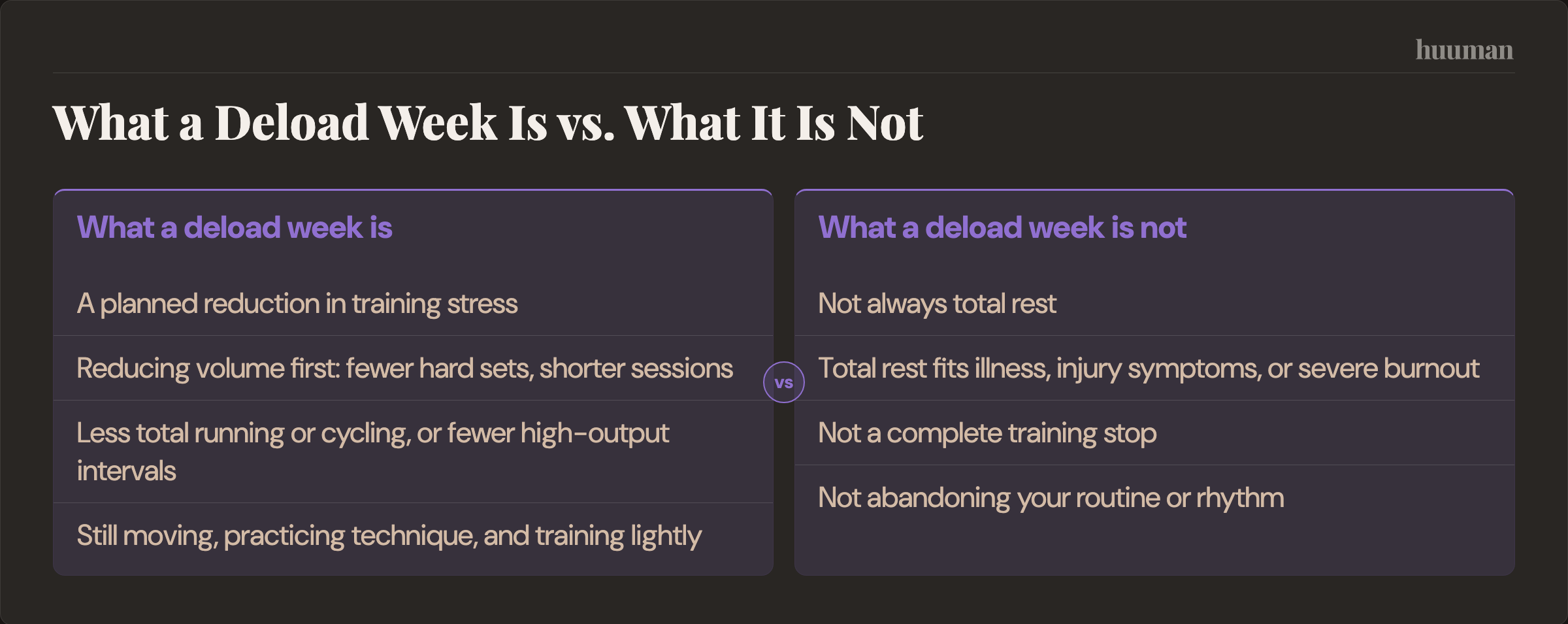
It is not always total rest. Total rest can be appropriate after illness, injury symptoms, or severe burnout, but many athletes respond better to easier training that maintains rhythm. A deload is also not the same as a competition taper. A taper is timed to express performance on a specific day. A deload is fatigue management within normal training.
The goal is to create enough relief that readiness improves without making the next week feel like starting over. That is especially important for people who use training to stay fit, confident, and capable in every phase of life, not just to hit a short-term peak.
Why you may need a deload: fitness, fatigue, and supercompensation
A common way to describe training is that fitness and fatigue can rise at the same time. During a demanding block, you may be getting fitter while also feeling worse if fatigue is masking performance. This is the general idea behind the fitness-fatigue model: training creates a temporary dip, recovery allows adaptation, and performance can rebound when the stress is appropriate. Treat it as a framing tool rather than a precise prediction.
The problem starts when the dip keeps deepening. If every week adds more hard work but recovery does not match it, the output you care about becomes less reliable. You may grind weights that used to move cleanly, run normal paces at unusually high effort, or need more caffeine and willpower to complete sessions that used to feel routine.
Paying attention to how training feels can help you catch this early. Cues like rating of perceived exertion, reps in reserve, warm-up speed, session difficulty, and mood before training are commonly used to gauge readiness. If your planned session calls for hard work but your warm-ups feel unusually heavy, adjusting that day may prevent the need for a larger reset later.
The most useful signs you need a deload week
The best signs you need a deload week are clustered, persistent, and unusual for you. One bad workout is not enough. A week of worsening outputs across multiple signals deserves attention.
- Repeated performance drop at the same effort: the same load, pace, or power now feels substantially harder, or performance falls even when effort is high.
- Stalled progress across multiple sessions: you are executing the plan, but reps, speed, endurance, or quality are flat or declining.
- Persistent fatigue: heavy legs, low drive, or whole-body tiredness lasts beyond a couple of easier days.
- Sleep disruption: you struggle to fall asleep, wake unrefreshed, or notice lower sleep efficiency when training stress is high.
- Resting heart rate and HRV trends: resting heart rate trends upward or HRV trends downward in the same window as poor training and poor recovery.
- Soreness that is disproportionate: normal delayed soreness after a new stimulus is one thing; soreness that feels excessive, lingers, or returns in the same tissues can point to under-recovery.
- Niggles that stop behaving normally: tendon, joint, or connective tissue discomfort no longer improves during warm-up, or it changes how you move.
- Technique breakdown: timing, coordination, bracing, foot strike, or bar path becomes less consistent even at familiar workloads.
- Lower motivation or irritability: you do not just dislike one session; you dread training or feel unusually reactive outside the gym.
- Feeling run down: repeated minor illness, low appetite, or reduced libido can be relevant when they appear with other fatigue signals, though they are not specific to training.
If soreness is your main question, use a narrower lens before deciding. The guide on working out with sore muscles separates normal muscle soreness from pain patterns that deserve modification.
The lookalikes: when it may not be a deload problem
Not every bad training block means the program needs a deload. Sometimes the training is exposing a recovery problem somewhere else.
- Under-fueling: a calorie deficit, low carbohydrate intake, dehydration, or inconsistent meals can make normal training feel punishing, especially during high-volume blocks.
- Sleep debt: travel, late work, early wake-ups, alcohol, or fragmented sleep can mimic overreaching quickly.
- Acute illness: a sudden drop in performance with elevated fatigue may be the first sign you are getting sick.
- Life stress: deadlines, conflict, caregiving, and constant cognitive load change readiness even when training volume is unchanged. If that sounds familiar, understanding mental overload may be more useful than adding another recovery hack.
- Program design: too many near-failure sets, too much high-intensity conditioning, no easy days, monotony, or a rapid load spike can create fatigue faster than you can adapt.
The distinction matters because the fix changes. If food and sleep have collapsed, a deload without correcting those inputs may only give partial relief. If pain is rising from technique breakdown or load spikes, reducing stress helps, but the movement problem still needs attention.
Deload readiness score
This checklist is a decision aid, not a diagnosis. Give yourself one point for each item that has been true for several days, especially if it is unusual for you.
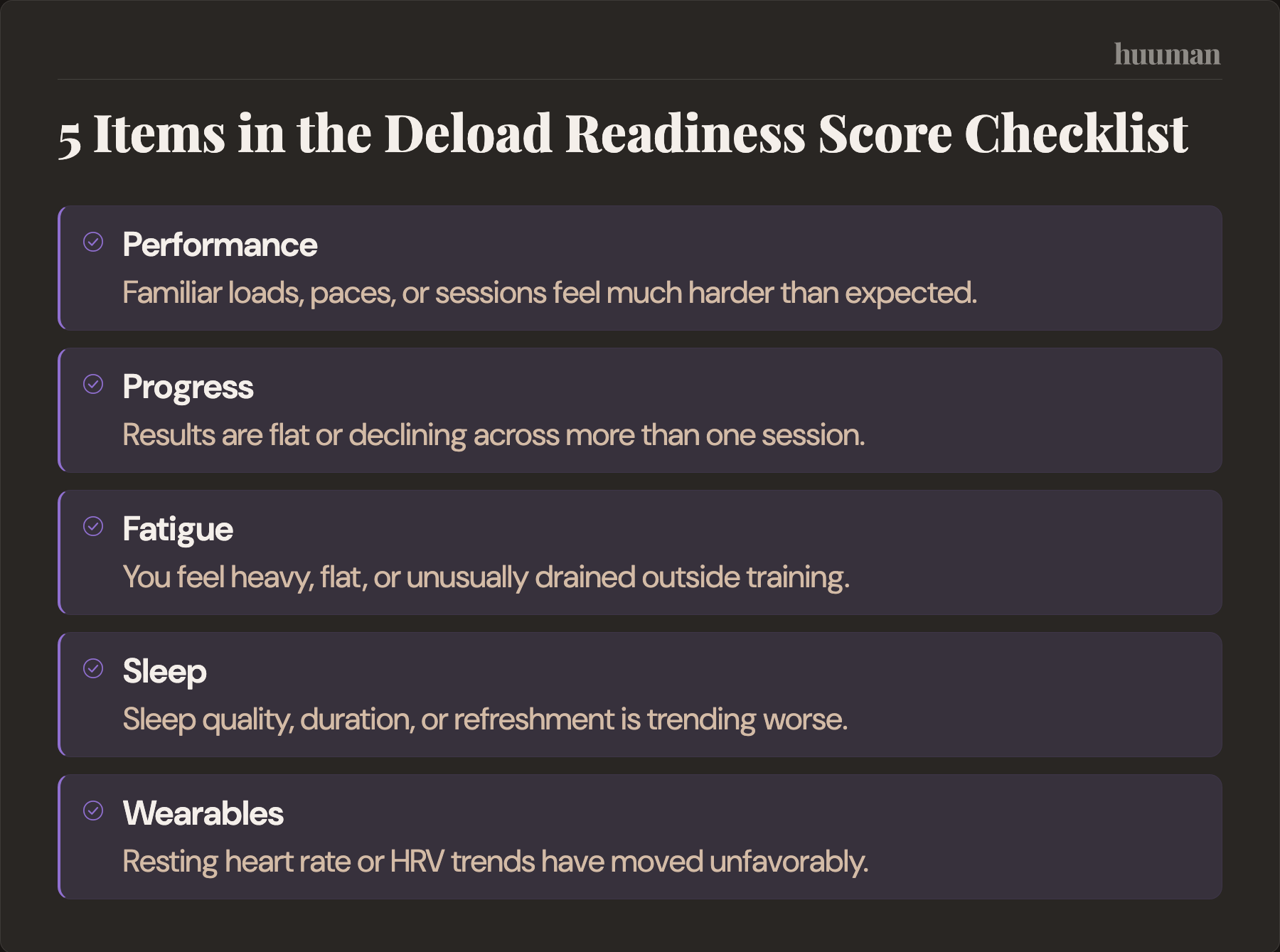
- Performance: familiar loads, paces, or sessions feel much harder than expected.
- Progress: results are flat or declining across more than one session.
- Fatigue: you feel heavy, flat, or unusually drained outside training.
- Sleep: sleep quality, duration, or refreshment is trending worse.
- Wearables: resting heart rate or HRV trends have moved in the wrong direction for you.
- Soreness: soreness is disproportionate, widespread, or interfering with normal movement.
- Niggles: tendon or joint discomfort is increasing or changing technique.
- Motivation: you dread sessions you normally enjoy.
- Stress load: work, travel, alcohol, dieting, or illness exposure is unusually high.
- Autoregulation: warm-ups and early sets consistently feel worse than planned.
If you score 0 to 2, adjust the day and watch trends. If you score 3 to 5, consider reducing training stress for several days. If you score 6 or more, a more deliberate deload is often the lower-risk choice. If you notice symptoms like pain, swelling, dizziness, chest pain, fainting, fever, neurological symptoms, or inability to bear weight, treat it as a medical or injury question rather than a programming one, and consider getting evaluated by a qualified professional.
Evidence and limits
Deloading is widely used in periodized training and coaching practice, but direct research comparing “best deload methods” is limited. The strongest practical reasoning comes from broader training principles: fatigue accumulates, recovery capacity is finite, and performance can be masked by short-term fatigue.
Overreaching is often described on a spectrum. Functional overreaching is generally characterized as a short-term increase in fatigue that may be followed by rebound performance when recovery is adequate, while non-functional overreaching is described as a longer, less productive state where performance decline and fatigue persist. Overtraining syndrome is more severe and complex, often involving prolonged underperformance and broader symptoms. Most recreational athletes are not diagnosing overtraining syndrome; they are deciding whether accumulated fatigue has outrun recovery.
Wearables can add context but should not make the decision alone. Metrics like HRV, resting heart rate, sleep duration, and sleep efficiency tend to be most useful when compared with your own baseline and read alongside training logs, soreness, mood, and performance. Treat HRV as a decision-support tool rather than a definitive verdict.
Because no external sources were provided for this article, specific claims about ideal deload length, exact frequency, immune effects, or wearable thresholds are intentionally kept broad. Treat the following strategies as commonly used approaches in training practice, not universal rules.
Strategies to discuss with a professional
Choose the deload lever
Many deloads start by reducing volume, since total work is often considered a major driver of fatigue and is relatively easy to adjust without losing technique. Intensity, frequency, and modality can also be modified depending on the signal you are trying to manage.
- Volume deload: reduce total sets, reps, distance, or interval count while keeping movement quality sharp. This fits lifters with high set volume, bodybuilders, and hybrid athletes carrying too much total work.
- Intensity deload: reduce load, pace, power, or proximity to failure. This fits athletes who are grinding, straining, or repeatedly training near maximum effort.
- Frequency deload: reduce training days while keeping a few short sessions. This fits busy professionals whose life stress is temporarily high.
- Modality deload: swap heavy loading or high-impact work for lower-impact movement. This fits rising joint, tendon, or connective tissue irritation.
- Skill deload: keep light practice, mobility, easy aerobic work, and technical rehearsal. This fits athletes who want rhythm without adding much stress.
Examples by training type
For strength training, many programs keep the main movement patterns but remove hard sets, avoid grinding reps, and stop well short of failure. The goal is to leave the gym feeling better than when you started.
For hypertrophy training, the common move is to reduce total sets and avoid chasing soreness. Easy pump work can maintain the habit, but the session should not become a disguised hard workout.
For endurance training, the deload often reduces duration and total weekly stress. Some athletes tolerate a small touch of intensity, while others do better with easy aerobic work only. Hybrid athletes usually benefit from choosing one priority to maintain lightly while deloading the other more aggressively.
For busy professionals, the minimal effective path is often simple: keep a few short sessions for movement quality, reduce the work that creates the most fatigue, and prioritize sleep and nutrition consistency. Recovery tools like hot tubs for muscle recovery or breathing practices such as the 4-7-8 breathing technique may help some people relax, but they do not replace smarter load management.
Deload, rest, or medical check
- If performance is down but recovery is normal: adjust the day, check technique, and monitor the next few sessions.
- If performance and recovery are both trending down: a deload is often reasonable.
- If pain is rising or movement is changing: modify loading and consider a qualified clinician or physiotherapist.
- If red flags appear: stop training and seek medical evaluation. Red flags include chest pain, fainting, new severe shortness of breath, fever, swelling, instability, inability to bear weight, numbness, weakness, rapid unintended weight loss, persistent insomnia, or mood symptoms that feel unsafe.
How to track and interpret changes
The point of tracking during a deload is not to prove you were right. It is to see whether fatigue drops while the training habit remains intact. Track enough to reveal a trend, not so much that recovery becomes another source of stress.
- Daily readiness: low, moderate, or high based on energy, mood, and willingness to train.
- Sleep: duration, perceived quality, and whether you woke refreshed.
- Soreness: muscle soreness separated from joint or tendon discomfort.
- Session RPE: how hard the session felt compared with what it should have felt like.
- RPE drift: whether easy work stayed easy or became harder as the session progressed.
- Wearables: resting heart rate, HRV trend, sleep efficiency, and any obvious mismatch with how you feel.
- Next-session performance: whether warm-ups, coordination, and output start to normalize.
A filled 7-day tracker example might look like this: Day 1, readiness low, sleep poor, soreness high, resting heart rate above personal baseline, HRV below usual, session changed from heavy lower body to easy mobility. Day 3, readiness moderate, sleep improving, soreness lower, easy bike session stayed easy. Day 7, readiness high, warm-ups feel normal, no joint pain, training resumes with conservative loading rather than an immediate max effort.
Environment can matter too. If neck discomfort or sleep position repeatedly disrupts sleep, equipment choices such as an anti-aging pillow are less important than whether they actually improve comfort and sleep consistency for you.
Once you see the pattern, your huuman Coach can build weekly plans around recovery and training trends so volume, cardio, and harder sessions fit your actual readiness instead of a rigid.
Signal vs noise
- One bad workout: noise unless it repeats. Check sleep, food, hydration, and warm-up quality before changing the whole week.
- A week of declining performance: stronger signal, especially if effort is higher. Reduce stress and monitor whether outputs rebound.
- Normal soreness after novelty: expected after new exercises or higher eccentric work. Keep movement easy and avoid adding more novelty immediately.
- Joint or tendon pain that changes mechanics: not normal training soreness. Modify loading and consider professional assessment if it persists or worsens.
- One poor night of sleep: not enough to declare under-recovery. Use a lighter day if needed and watch the next few nights.
- Several nights of fragmented sleep: a meaningful recovery signal. Address sleep timing, stress, alcohol, caffeine, and training intensity together.
- Low HRV alone: incomplete information. Compare it with mood, performance, resting heart rate, and recent stress.
- High motivation with rising pain: risky mismatch. Let the tissue signal outrank the mental desire to push.
- Life chaos plus hard training: often creates hidden overload. Reduce the most fatiguing work first and keep the habit intact.
Common questions
What are the most common signs you need a deload week?
The most common signs are a repeated performance drop, higher RPE for normal work, persistent fatigue, worse sleep, unusual soreness, rising joint or tendon niggles, low motivation, and wearable trends that suggest reduced recovery. The strongest case is a cluster, not a single symptom.
How do I know if I need a deload or I am just sore?
Muscle soreness after a new stimulus can be normal, especially if performance and mood are otherwise fine. A deload becomes more relevant when soreness is disproportionate, keeps interfering with normal movement, appears with poor sleep and poor performance, or includes joint and tendon discomfort rather than only muscle tenderness.
Will I lose strength or muscle if I take a deload week?
A short reduction in training stress is unlikely to erase meaningful progress for most consistent athletes. The bigger risk is often forcing high-effort training when fatigue is masking performance and technique is deteriorating. The deload should be easy enough to recover from and structured enough to maintain rhythm.
How often should you deload when lifting?
There is no universal schedule. Some lifters plan deloads around training blocks, while others use autoregulation and take them when performance, recovery, and pain signals justify it. If you want more detail on timing, read how long a deload should last.
Should I deload when cutting calories or trying to lose fat?
A calorie deficit lowers recovery capacity for many people, especially when combined with high training volume. That does not automatically require a deload, but it raises the value of monitoring performance, sleep, soreness, mood, and hunger. If several signals worsen together, reducing volume is often the first lever to consider.
Can I do cardio during a deload week?
Many people keep easy cardio during a deload if it feels restorative and does not worsen fatigue or pain. The key is avoiding the trap of replacing reduced lifting stress with hard conditioning stress. Easy movement should leave you feeling better, not depleted.
How long should a deload last if I feel burnt out?
Use response rather than a fixed rule. If fatigue is mild, a shorter reduction may be enough. If sleep, motivation, soreness, and performance have all been poor, you may need a more deliberate reset and a slower return. If burnout includes persistent insomnia, mood symptoms, or physical red flags, involve a qualified professional.
For the bigger picture, recovery is not only a deload topic. Training, sleep, stress tolerance, and long-term health habits all shape whether you can stay in your prime. If you like deeper health reading, a longevity book can be useful, but your daily trend data usually tells you what to fix first. For family or performance stress that affects routines, resources on concentration problems in children or overcoming stage fright may also connect recovery to real-life.
A deload is a tool for protecting momentum. The best athletes are not the ones who ignore fatigue; they are the ones who notice when the signal changes, reduce the right stressor, and return before compensation turns into breakdown.
More health topics to explore
- Sleep & Recovery – Overview
- How Much Sleep Do Babies Need? Age Guide + Practical Tips for Parents
- What a 100 Sleep Score Really Means: Oura, Garmin, Fitbit, Eight Sleep
- Sleep Duration at Age 3: Guidelines, Naps & a Practical Reality Check
References
- Bellinger P — Functional Overreaching in Endurance Athletes: A Necessity or Cause for Concern? (2020)
- Meeusen et al. — Overtraining Syndrome: Prevention, Diagnosis, Treatment (2013)
- Cappuccio FP et al. — Sleep duration and all-cause mortality: a systematic review and meta-analysis... (2010)
- Cupka M & Sedliak M — Hungry runners — low energy availability in male endurance athletes and its i... (2023)
About this article · Written by the huuman Team. Our content is based on peer-reviewed research and clinical guidelines. We follow editorial standards grounded in scientific evidence.
This article is for educational purposes only and does not constitute medical advice. Health and training decisions should be discussed with qualified professionals.

